Friday, 27 April 2018

POST 15: INDIVIDUAL DOCUMENT AS ILLUSTRATION OF 'SPACES & EXCHANGES' NOTION

Image associée


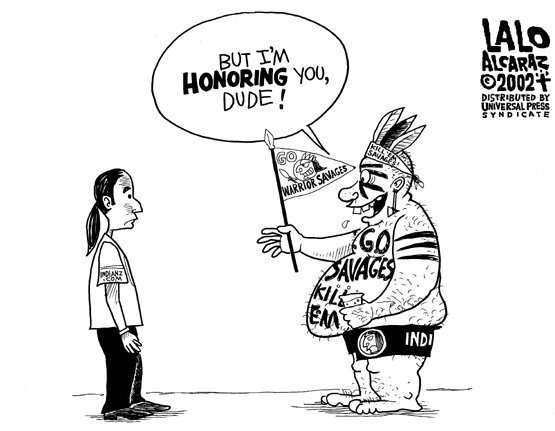
Drawn by Lalo Alcaraz in 2002, this cartoon was distributed by "Universal Press Syndicate" - it was an independent press syndicate - in order to denounce the way US people consider Native Americans cause. The artist is an American cartoonist most known for being the author of the comic La Cucaracha which has become one of the most controversial in the history of American comic strips. 

American history is marked by the conquest of the West, which was a period in which settlers arrived in a new space and forced those already inhabiting the territories to adapt to themselves.


This cartoon is a clear criticism of how American people are misinformed on the Native American cause and have many clichés on it. It is exemplified by the way the right-side character bers the typical war-paintings associated with Native American warriors.
Moreover Indian culture has become something commercial and ,worst of all, a reason to disguise on Halloween or Carnival - as shown by the way the American is dressed up, a feather hat and tomahawk earrings.
Also, we can see the disregard they have for this cause - and how they use it as a distraction - because the American has painted on himself some mottos as some sports fans would do, he has also a drink in his hand and a flag in his other hand. The inscriptions he has painted also have a very cliché meaning as it is "Kill 'em", which is not a very elaborated message.

The document illustrates well the notion of Spaces & Exchanges as it refers to the Cultural Shock that may happen when two different cultures meet each other. Indeed, it involves a change of area and also a lot of exchanges !

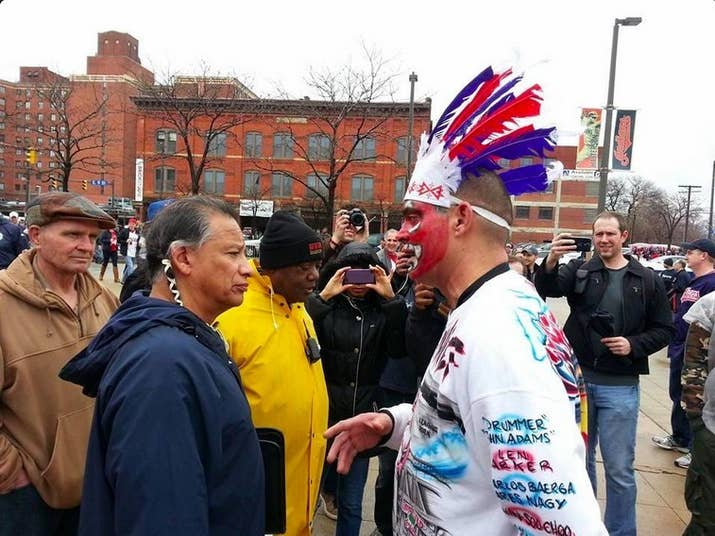
A Native American who was protesting the Cleveland Indians logo had this rather awkward encounter with an Indians fan.
This picture shows a true encounter between a Native American and an Indian fan. It is very relevant and a bit incredible because it's exactly the same situation as in the cartoon, yet it is not a set up.

POST 14: OUTSOURCING/OFFSHORING: Two Cartoons

Outsourcing/Offshoring

 In the first cartoon, we can see a man standing on a little island which is suppose to represent the Cayman Islands, a notorious Caribbean tax haven - a country or independent area where taxes are levied at a low rate - while, far away behind him, there are two others tax heavens : Bermuda and Switzerland.
On the left of the image, seated on the bow of a boat bearing a phrase - which is almost the same of Mitt Romney's motto "We believe in America" - there are two characters who seem to be children. Both are listening attentively to the man : he explains them what's the difference between outsourcing and offshoring and how it's a good deal to do it. Thanks to his face and his motto we can easily recognize the American businessman and politician who was the Republican Party's nominee for President of the United States in the 2012 election. The kids look amazed by his speech and even suggest him to become president !
Here, the cartoonist is clearly criticising the corruption of politicians that value profit over anything else as well as the American people's way of thinking regarding their reaction to the treasure chest full of dollars.
There is also a criticism of a globalised system where some spaces or countries are completly exploited for personal profit with no regards for the population, and where people who were supposed to better the future of humanity lie and cheat on the system they are meant to enforce.


MATSON, Cagle Cartoons, 2012

This second cartoon is much more simplistic as it is only made up of three frames in which two characters are having a discussion. It was published on the GEEK and POKE  blog in 2008 in order to explain in a very simple - and satirical - way the issue of offshoring jobs.
Of course, we already know it thanks to Mitt Romney(from the first cartoon), but let's see how these men describe it !
According to the way they are dressed and what we read in the balloons, we can be a hundred percent sure that these characters are business leaders or, at least, businessmen. Thus, the first one is talking about a decision that his company has taken because of what "the folks" wanted, whereas the other one seems to be astonished. Indeed, people simply wanted to get paid for their hard work so the company just had to move to the next country.
The irony of this cartoon is explicit enough as what they are saying is completely staggering and absurd : no one could really have this sort of thougths ! The cartoonist is obviously criticizing business leaders who seem to have not a single hint of empathy regarding their employees and adopt an inhuman behaviour. We can also grasp that the author is denouncing our actual labor market which is entirely disconnected from the reality of "normal" people, favouring offshoring, and yearning only for profit, disregarding working conditions.

https://www.datamation.com/img/2008/03/offshoring.jpg
GEEK And POKE, 2008


In conclusion, these two documents are related to the notion spaces & exchanges as both criticise offshoring and how the internationalisation of exchanges and disappearence of tax borders has evolved in the wrong way, loosing the advantages that it offered to the people. Moreover, it has created more inequalities between spaces as some received all the profits of this new form of exchange while others are completely put aside. 


Wednesday, 21 February 2018

Post 7 : The power of the intergenerational transmission

To begin with, power is the capacity or abilty to direct or influence the behaviour of others or the course of events. In order to illustrate the power of life's notion, I will adress the subject of intergenerational transmission. 

Résultat de recherche d'images pour "khalil gibran"First of all, I would introduce a little biography of the text's author : 
Khalil Gibran is a lebanese artist, poet and writer. He was born in 1883 in Bsharri ( Lebanon ) and immigrated to the US along with his mother and his siblings in 1895. Three years later he returned to Lebanon, where his father stayed, to pursue his studies. Eventually, due to one of his siblings death he came back and settled in the US. His work, written in both Arabic and English, express his deeply religious and mystical nature.

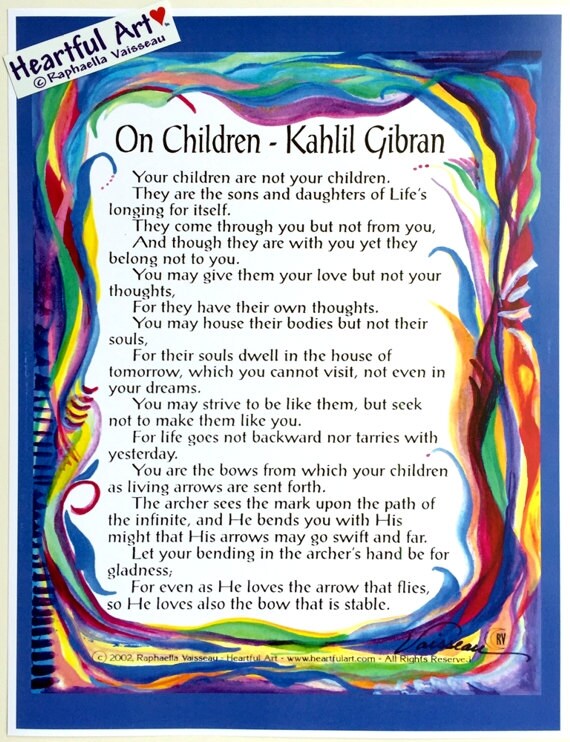
Then, this short extract - which is, in fact, a whole chapter of a "small jewel" of literary entitled The Prophet - is a poetic guide about education and aimed at parents or futur parents.
Image associée
Here, the narrator encourages parents not to influence their chlidren but to let the Life - and God - do its work and to let them discover and create their own destiny whitout pre-conceived ideas in their mind. Personally, I find this advice very well thought out and positive, in the sens that if you look at the doxa, the comparison is quite original. Indeed, parents are too often too much protective and intrusive against their children, as if they were sorts of "projection" of themself. 

The Prophet is a book of 26 prose poetry fables written in English and translated into over 40 different languages : it's Khalil Gibran's best known work. It tells superficially the story of an old man, Amustafa, considered as a prophet by the people of the city of Orphalese. He was about to leave them when they stopped him to heard his latest advice about all kind of topics like freedom, time, beauty, crime and punishment, but also about clothes or houses. It is, therefore, a matter of transmission as Khalil Gibran is sharing his own knowledge, life experiences and conclusions with us, through Amustafa's philosophy.
I've got a particular affection for this book, because I find it very moving, strong and deeply Wise and positive. It helps me a lot in my quest for identity.

To me, the power of the intergenerational transmission is very strong and important for several reasons :
  • It makes us able to avoid repeating mistakes and look toward the futur with more serenity. 
  • It creats a deep conection between every generations : they produce an impact on our world and help us to build our personal identities.
  • It continues a vital and perpetual movement : giving, receiving, giving back.
Image associée


Moreover, we can draw a parallel as well as a distinction between The Prophet and the documents seen is class about gun culture in America. Indeed, the tradition of carrying firearms comes from the Second Amendment of the United States Constitution which is, of course, a transmission. De facto, it is obvious that not all types of handover are good as they are outdated and cannot be applied.
To put it in a nutshell, Both the documents seen in class and this masterpiece are related to the notion of passing on, yet those seen in class pass on an idea linked to the power of death as opposed to this text ( and The Prophet as a whole ) which emobodies the power of Life itslef and its continuity.


Monday, 5 February 2018

Post 6 : THE US GUN CULTURE


The Brady Campaign to Prevent Gun Violence
The Brady Campaign to Prevent Gun Violence, 2010

The Brady Campaign to Prevent Gun Violence and the Brady Center to Prevent Gun Violence are affiliated American nonprofit organizations that advocate for gun control and against gun violence.
Together, they are commonly reffered to as the Brady Campaign.
It was founded in 1974 as the National Council to Control Handguns (NCCH).

This poster forms part of the 2010 Campaign to prevent gun violence and it raises the  issue of US gun culture.
It's composed of three principal elements : the controversial Brady Campaign´s logo (in the botton left corner of the page), a series of figures with the American motto "God Bless America" (at the top) and a huge gun in the colors of the national flag, the Stars and Stripes.
The designer of this poster aims to draw attention to a few elements which are very clearly disposed : first, the gun is a true eye-catcher and we could ask ourselves if this campaign is for or against weapons bearing...so we finally pay attention to the text and the word "murdered" catches the eye. Indeed, it describes the number of shot deaths in seven countries in only one year : the highest belongs to the United State of America, 9,484, while the others not exceed 200. This figure is not really surpising in itself  given that the bearing of arms is a constitutionally guaranteed right.
This his obvious that the goal of this poster is surely to make us react to gun violence - which is very present and rooted in American culture - by demonstrating to us the extent of the problem. However, we can noted that this kind of campaign have not real impact on the society, given that weapons still are allowed in most states of the country.
2010 Graphs
These documents are two graphs that had been published by the the United Nations Office on Drugs and Crime  in 2010 (UNODC : it's a United Nation office that was established in 1997 to assist the UN in better adressing a coordinated, comprehensive response to the interrelated issues of illicit trafficking in and abuse of drugs, crime prevention and criminal justice, international terrorism and political corruption). The first one represent the top 10 countries organised by gun murder rate and the second one also represents gun murder rate of some developed countries : both are based on the latest data for each country from 2004 to 2010.
They teach us that, even if the United States of America are massively hit by gun murder (3,2) compared to Japan (0), New Zealand or Germany (0,2), they are only ranked 26th on a worldwile scale (far behind  Honduras, El Savador and Jamaica !). The ranking is established following the Human Development Index (HDI), which is a composite statistic of life expectancy, education and per capita income indicators : a country scores higher HDI when the lifespain is higher, the education level is higher and the GDP per capita is higher.
Thus, these two documents also tackle the issue of gun violence but allow us to put it back in its context : weapons - and above all the violence that comes along with it ! - are a real problem in the all world.  As it is an official document, it has no under message and only helps raising the awareness of the gun problem in the world, in particular in South America. Yet, we can go as far as to relate it with the stranglehold of the USA on this region and their strategy aiming to maintain it in a state of dependance ( by fueling the gun violence ).


Next, these two cartoons were made by Steve SACK (in 2010) and Dave GRANDLUND (in 2013) in order to critizice the gun lobby power in the USA which impeed the legislation to enact laws about gun regulation or simply against gun bearing.
Steve SACK, on www.startribune.com,
Gun Lobby and Congress (2010)

Indeed, the Second Amendment to the United States Constitution protects explicitly the right of the people to keep and bear arms (it was adopted on December 15, 1791,
as part of the first ten amendments contained in the Bill of Rights), hence, numerous associations were born to protect this legal permission. This is exactly the case for the NRA (National Rifle Association of America)  which is an American nonprofit organization that advocates for gun rights : it was founded in 1871 and has directly lobbied for and against legislation since 1975.

Therefore, the first caricature is composed of two main elements : the United States Congress - whose stairs are drooling of blood - and two men with one suitecase each - who represent the gun lobby and all Congress deputies - trading money. It also includes a ballon in which we can read "Now, where were we, before we were so rudely interrupted...". It's more than clear that this is a terrible criticism of political corruption and gun lobby control over the legislative system.
Dave GRANDLUND, on www.davegranlund.com, 
Second Amendment and NRA (2013

The second one is divided into two statues : the first one represents an old soldier with a rifle and, the other, a very big man armed with heavy weaponry and standing on five "ammo" cases.
On the left, there is a caption  which helps us to understand that this is the real and original version of the Second Amendment as it was wanted by the Fouding Fathers and, at the right, which defined by the NRA.
To precise, the Founding  Fathers of the United States were those led the American Revolution against the Kingdom of Great Britain and contributed to the establishment of their own country - they also drafted the Declaration of Independence.
Thus, we can deny that gun violence is a real issue in the United States of America - as in everywhere in our world - because the gun tradition is firmly anchored in US culture (firstly because of this Second Amendment and currently fueled and totally blocked by gun lobby).  In my opinion, we must understand that this amendment was made during a certain context in which life was harder ...however, this context has improved a lot and gun possession is more a danger for the national security than a real personal protection...